
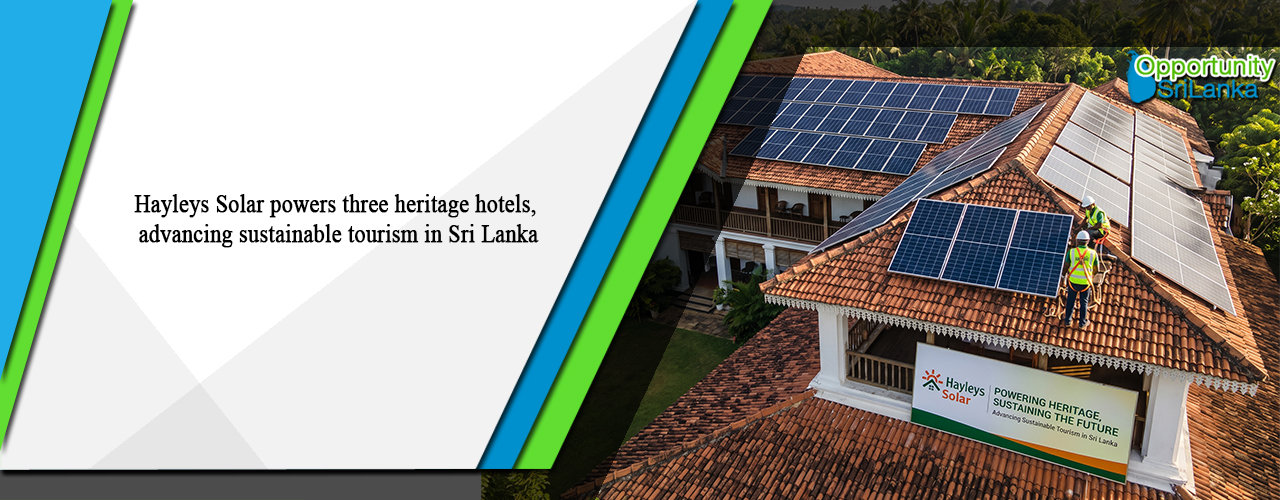
Hayleys Solar powers three heritage hotels, advancing sustainable tourism in Sri Lanka
Daily FT: Hayleys Solar has successfully completed solar power installations across three leading hospitality properties: Golden Star Beach Hotel (240 kWp), Tangerine Beach Hotel (780.57 kWp), and DoubleTree by Hilton Weerawila (280.25 kWp), supporting the hospitality sector’s transition toward renewable energy and more sustainable operations.
Having welcomed generations of local and international travellers for decades, the transition to solar energy reflects each property’s commitment to balancing exceptional guest experiences with environmental stewardship.
Together, the three installations are expected to offset approximately 1,356 tonnes of CO2 emissions annually, equivalent to taking hundreds of vehicles off the road each year, while reducing the properties’ reliance on grid electricity.
Hayleys Fentons Managing Director Hasith Prematillake stated: “These installations demonstrate how renewable energy can support the hospitality sector in building more sustainable and efficient operations. We remain committed to enabling businesses across Sri Lanka to accelerate their transition to clean energy through reliable and innovative solar solutions.”
Hayleys Fentons Deputy Managing Director – Energy Roshane Perera stated: “The hospitality sector plays a vital role in Sri Lanka’s economy and global tourism appeal. By enabling these hotels to transition towards renewable energy, we are not only reducing their environmental footprint but also strengthening their long-term operational resilience. This milestone reflects our continued commitment to powering sustainable tourism through innovative solar solutions.”
With this milestone, Hayleys Solar reaffirms its position at the forefront of Sri Lanka’s renewable energy transition, continuing to partner with key sectors of the economy to build a more sustainable and resilient future.
OSL take:
Sri Lanka’s growing focus on renewable energy generation and sustainable tourism is creating new business and investment opportunities for foreign companies/investors seeking to participate in the country’s transition towards a greener economy. The recent completion of solar power installations by Hayleys Solar at three leading hospitality properties – Golden Star Beach Hotel, Tangerine Beach Hotel and DoubleTree by Hilton Weerawila – highlights the increasing commercial potential of integrating renewable energy into the tourism industry. With hotels and resorts seeking to reduce operating costs, lower their carbon footprints and meet increasingly stringent environmental expectations among international travellers, demand for solar power, energy storage systems and energy-efficient technologies is expected to create opportunities for foreign businesses/investors and technology providers. Business/investment potential extends beyond rooftop solar installations to utility-scale solar and wind power generation, battery energy storage systems, hybrid renewable energy projects, smart grids and other supporting infrastructure. Foreign companies could also explore partnerships with local energy developers, technology suppliers and industrial operators. At the same time, the expansion of sustainable tourism offers opportunities in environmentally friendly hotels and resorts, eco-lodges, nature-based tourism facilities, sustainable transport, waste management, water conservation and energy-efficient hospitality infrastructure. Sri Lanka’s natural resources, including its solar and wind potential, biodiversity and diverse tourism destinations, provide a foundation for developing an integrated renewable energy and sustainable tourism market. There is also growing scope for foreign businesses/investors to introduce international environmental standards, green building technologies and carbon management solutions to the hospitality sector. For international businesses, the opportunity lies in participating in two increasingly interconnected industries. Renewable energy investments can help make tourism operations more cost-efficient and environmentally responsible, while sustainable tourism can generate additional demand for clean energy technologies and green infrastructure.