
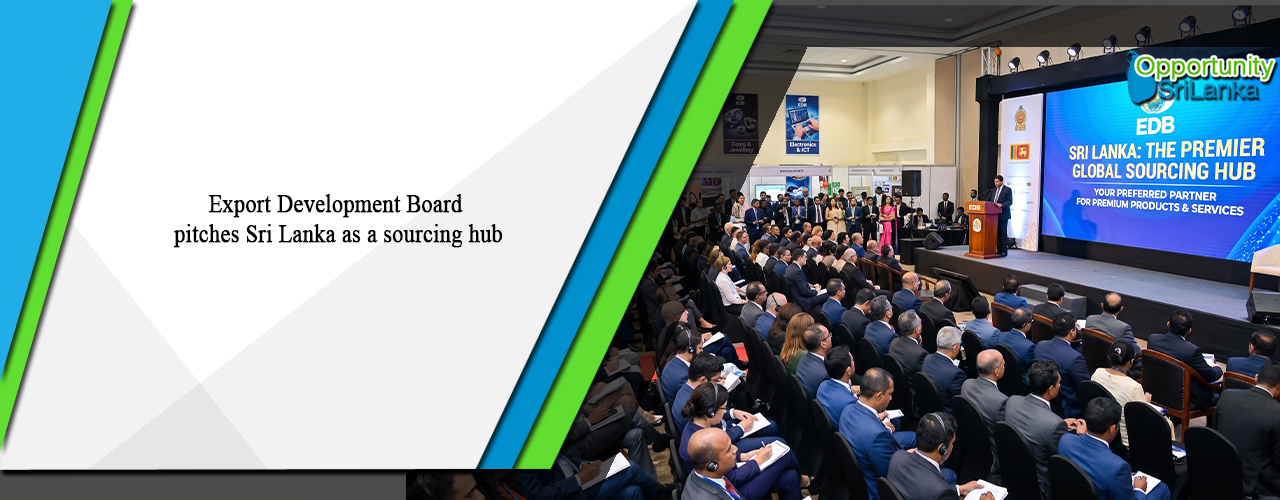
Export Development Board pitches Sri Lanka as a sourcing hub
The Morning: Sri Lanka has positioned itself as a competitive sourcing and investment destination, leveraging its premium products, manufacturing capability, strategic location, and market access, according to Export Development Board (EDB) Chairman Mangala Wijesinghe.
Wijesinghe said investors looking at Sri Lanka would find more than a single product or service.
“When you look at Sri Lanka as a sourcing destination, you will not find just one particular product or service. You will find a combination of quality manufacturing, a skilled workforce, a strategic location, and market access. Compared with other destinations, Sri Lanka is a very good destination for investment,” he said.
He added that the Government’s stance on corruption and transparency provided investors strong protection. “The incumbent Government is very concerned about corruption and the transparency of Government agreements. Therefore, we also have very good investment protection,” he said.
According to Wijesinghe, merchandise exports, driven mainly by agriculture, rubber, coconut, and food and beverage, account for 70% of the country’s exports, while services, including IT/BPM, transport, logistics, and construction, account for more than 22%.
He added that half of Sri Lanka’s exports went to the US and the European Union, with exports having grown steadily over the past eight months despite challenges.
Highlighting the country’s agricultural strengths, he said that Sri Lanka was well recognised for premium and heritage products such as Ceylon Tea, Ceylon Cinnamon, coconut products, spices, and tropical fruits and vegetables, as well as for ethical and sustainable agricultural practices, which were driving growing demand for value-added products.
Sri Lanka produces more than 80% of the world’s true cinnamon, which carries Geographical Indication (GI) certification.
On manufacturing, Wijesinghe identified apparel, rubber, electrical and electronics, and ICT as key sectors. He described apparel as one of the country’s main export sectors, with international demand driven by its ethical manufacturing practices.
He noted that the rubber sector, a leading global supplier of natural rubber, was moving into industrial, healthcare, and automotive products.
Wijesinghe added that the electrical and electronics sector was recording annual growth of 20–30%, with a diverse range of products including sensors, sophisticated electrical systems, and industrial electronics and Electric Vehicle (EV) electronics, while the ICT sector was growing at 10–15% annually.
The EDB Chairman also pointed to Sri Lanka’s location on East–West shipping routes linking the Middle East, Africa, Asia, and Europe, as well as its free trade agreements with India, Pakistan, and Singapore. He added that the Government was working to streamline its agreement with Thailand.
“With our strategic location, talent pool, and market access, we have very good access to international markets,” he said.
OSL take:
Sri Lanka is positioning itself as a competitive sourcing and investment destination for international businesses/investors, offering opportunities across premium agricultural products, manufacturing, food processing, information technology and export-oriented services. EDB Chairman Wijesinghe has highlighted the country’s combination of quality manufacturing, skilled labour, strategic location and international market access as key advantages for foreign investors seeking to diversify sourcing operations and establish regional business partnerships. Merchandise exports, driven by agriculture, rubber, coconut and food and beverages, account for approximately 70% of Sri Lanka’s exports, while services, including information technology and business process management, transport, logistics and construction, contribute more than 22%, according to Wijesinghe. For foreign businesses/investors, the agricultural sector presents opportunities in value-added production, processing, packaging and distribution of Ceylon Tea, Ceylon Cinnamon, spices, coconut-based products and tropical fruits. Sri Lanka produces more than 80% of the world’s true cinnamon, which holds GI certification, providing potential for premium product development and international market expansion. Manufacturing offers further opportunities for companies seeking skilled workers, established production capabilities and access to international markets. Investors can also explore rubber-based products, food manufacturing, technology services and logistics infrastructure supporting cross-border supply chains. With approximately half of Sri Lanka’s exports destined for the United States and the European Union, the country provides an established export base for businesses targeting major international markets, subject to applicable trade requirements. As Sri Lanka seeks to diversify exports and attract foreign capital, international businesses/investors have opportunities to establish sourcing partnerships, develop local production facilities and introduce advanced technologies, strengthening the country’s role in global value chains while creating employment and generating export earnings.
| Article Code : | VBS/AT/20261026Z_4 |