
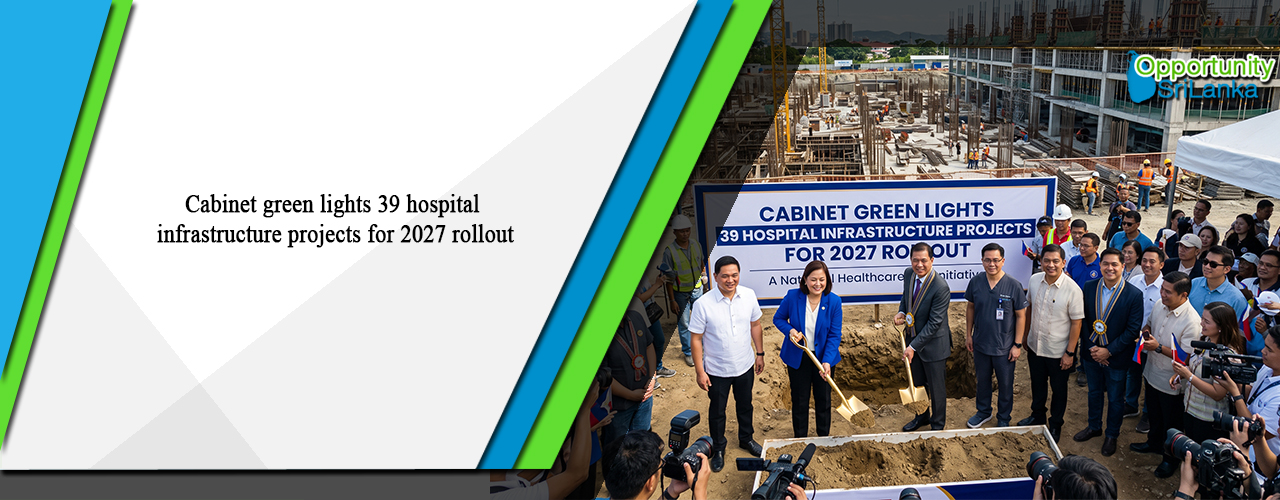
Cabinet green lights 39 hospital infrastructure projects for 2027 rollout
Daily FT: The Cabinet of Ministers has approved the implementation of 39 new development projects aimed at upgrading infrastructure across Government health service institutions, including hospitals, as part of a broader push to address long-standing infrastructure gaps and modernise health service facilities.
Cabinet Spokesman and Health Minister Nalinda Jayatissa has said the projects stem from a review of 41 proposals submitted during 2025 and 2026, evaluated by the Department of National Planning. Following that evaluation, the Department recommended the projects be initiated from 2027, and they have since been incorporated into the Public Investment Program for 2027–2031.
“Of the 41 proposals reviewed, 39 were assessed as ready for implementation, with provisions for these to be allocated through the 2027 Budget,” Jayatissa has said at a recent post-Cabinet media briefing.
He said the 41 proposals focus on infrastructure development at tertiary-level institutions, including district, teaching, national and specialised hospitals.
Turning to the Government’s ‘Arogya’ wellness centre initiative, Dr. Jayatissa framed it as part of a decades-old global consensus on strengthening primary healthcare, tracing the approach back nearly five decades to the WHO’s Alma-Ata Declaration.
Citing India’s Ayushman Bharat wellness centres as a reference model, he said Sri Lanka’s Arogya centres are intended to extend coverage to hospitals that were left out even under the World Bank-funded healthcare project of 2018–2019, while also covering provincial hospitals and B- and C-level facilities.
“Tertiary-level hospitals have reached capacity, particularly in OPD and clinic services, with patients often travelling long distances for care that could be delivered closer to home. The aim is to establish primary care facilities within a 1–2 kilometre radius, each designed to serve a defined population of around 10,000 patients,” he explained.
Leveraging advances in ICT, Jayatissa said the Government hopes to issue individuals a health number linked to their National Identity Card (NIC) number, enabling the maintenance of electronic health (e-health) records and allowing patients to be directed from primary care facilities to secondary, tertiary or specialised hospitals as needed.
Stating that the 2026 Budget allocated Rs. 1,500 million for this initiative, he said he hoped the Government would increase that allocation in the upcoming Budget 2027.
“Through this system, the Government intends to gradually reduce the patient population served per primary care centre from 10,000 to 5,000,” he added.
OSL take:
Sri Lanka’s expanding public investment programme is creating new opportunities for foreign businesses and investors across key sectors as the Government moves to modernise infrastructure and address long-standing capacity gaps. The approval of 39 new health infrastructure projects for inclusion in the 2027–2031 Public Investment Programme is one example, creating potential opportunities in construction, medical equipment, technology, engineering and facility services. Beyond healthcare, investment opportunities are emerging across energy, transport, ports, logistics, water, agriculture, tourism, manufacturing and digital services. Renewable energy and battery storage, in particular, are generating demand for international capital and technology, while infrastructure upgrades could strengthen Sri Lanka’s position as a regional trade and logistics hub. For foreign businesses/investors, the expanding development pipeline offers opportunities not only to finance projects but also to provide technology, expertise and specialised services. As Sri Lanka seeks to expand productive capacity and attract greater foreign investment, its development programme could increasingly serve as a platform for international businesses to establish partnerships and build long-term operations in the country.
| Article Code : | VBS/AT/20261001Z_4 |