
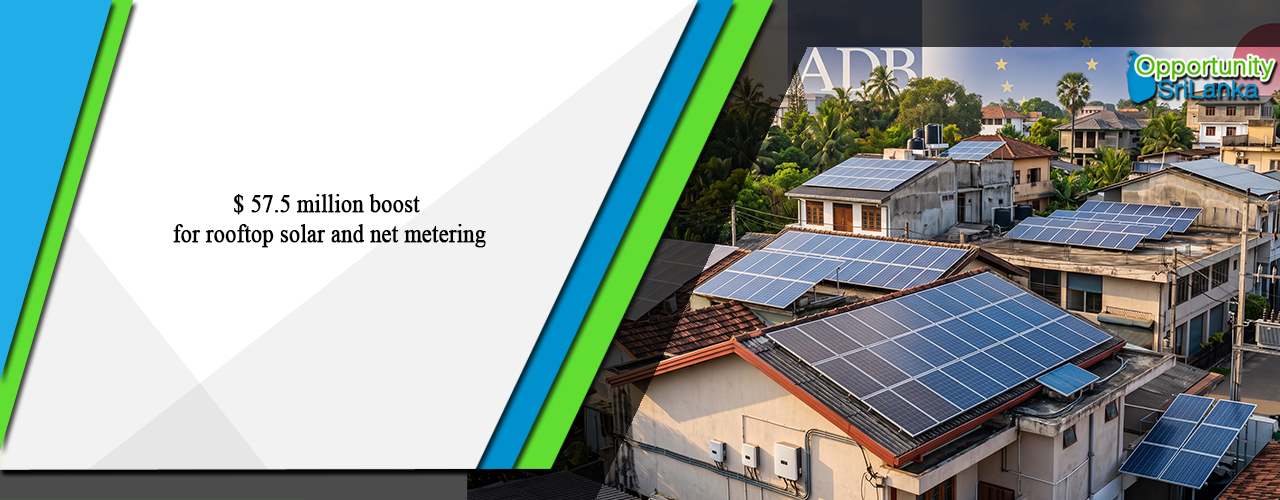
$ 57.5 million boost for rooftop solar and net metering
Daily FT:
The Government of Sri Lanka has entered into an agreement with the Asian Development Bank (ADB) to obtain a concessional loan of USD 35 million. The financing package also includes a grant of EUR 15.4 million from the European Union (EU), equivalent to USD 16.94 million, and a further grant of USD 5.5 million from the Japan Fund for the Joint Crediting Mechanism (JFJCM).
The Energy Ministry, together with Electricity Distribution Lanka Ltd. (EDL) and Lanka Electricity Company Ltd. (LECO), will carry out the project from 2026 to 2030 as part of the Government’s efforts to increase access to affordable and clean energy.
As part of the initiative, EDL’s CEBAssist solution will be upgraded through the introduction of an Advanced Metering Infrastructure (AMI) system, a Distributed Energy Resource Management (DERM) system, and distribution control centres supported by an Advanced Distribution Management System (ADMS). These technologies will improve the digital delivery of customer and operational services while strengthening electricity network reliability and enabling faster restoration of power following interruptions. Smart meters and related infrastructure will also provide real-time monitoring and control, supporting greater renewable energy integration and allowing more consumers to benefit from solar power. These improvements are expected to help EDL develop a smarter, more efficient, and more reliable electricity distribution network.
The project will also introduce Virtual Net Metering (VNM) in Sri Lanka for the first time. With funding from an EU grant, a combined rooftop solar photovoltaic (PV) capacity of 25 MW will be developed to help reduce electricity costs for small and medium-scale entrepreneurs. The solar installations will incorporate advanced control technologies, enabling the National System Operator to manage their electricity generation according to existing network limitations.
In LECO’s service areas, the project will include the installation of low-loss conductors to improve electricity distribution efficiency, alongside the VNM initiative. High-capacity battery energy storage systems installed at distribution transformer level will expand the network’s ability to accommodate renewable energy and improve control over its integration. Focusing particularly on the Negombo area, LECO plans to strengthen its network to accommodate additional high-capacity commercial and industrial consumers. These improvements will also support increased renewable energy integration while enhancing the flexibility, resilience, and reliability of electricity supply.
OSL Take:
Sri Lanka’s continued efforts to increase renewable energy generation and modernise its electricity infrastructure are creating new business and investment opportunities for foreign companies across power generation, grid infrastructure, and clean-energy technologies. The Government’s latest ADB-supported initiative, which focuses on advanced metering, distributed energy resource management, and smart-grid development, demonstrates the growing investment potential beyond traditional electricity generation. The project is expected to increase demand for smart meters, grid-management systems, battery storage, power electronics, digital energy platforms, and other technologies required to modernise the electricity network.
Renewable energy generation offers considerable potential for foreign investors, particularly in solar power, wind energy, rooftop solar installations, battery energy storage, and other clean-energy projects. The introduction of Virtual Net Metering and the planned development of 25 MW of aggregated rooftop solar capacity also create opportunities for companies providing distributed energy generation and management solutions. In addition, Sri Lanka’s rising electricity demand, renewable energy targets, and efforts to reduce reliance on imported fossil fuels could encourage investment through independent power projects, public-private partnerships (PPPs), joint ventures, and technology partnerships.
Further opportunities are emerging in battery storage, renewable energy forecasting, energy-efficiency technologies, and electricity network operations and maintenance. As Sri Lanka works to integrate increasing amounts of variable renewable energy into its national grid, demand for technologies that improve energy management, grid stability, and operational efficiency is likely to grow. Consequently, the country’s transition towards a more decentralised and digitally managed electricity system presents foreign investors with opportunities throughout the clean-energy value chain, including power generation, energy storage, grid-modernisation technologies, and energy-management services.
| Article Code : | VBS/AT/20261012Z_5 |