
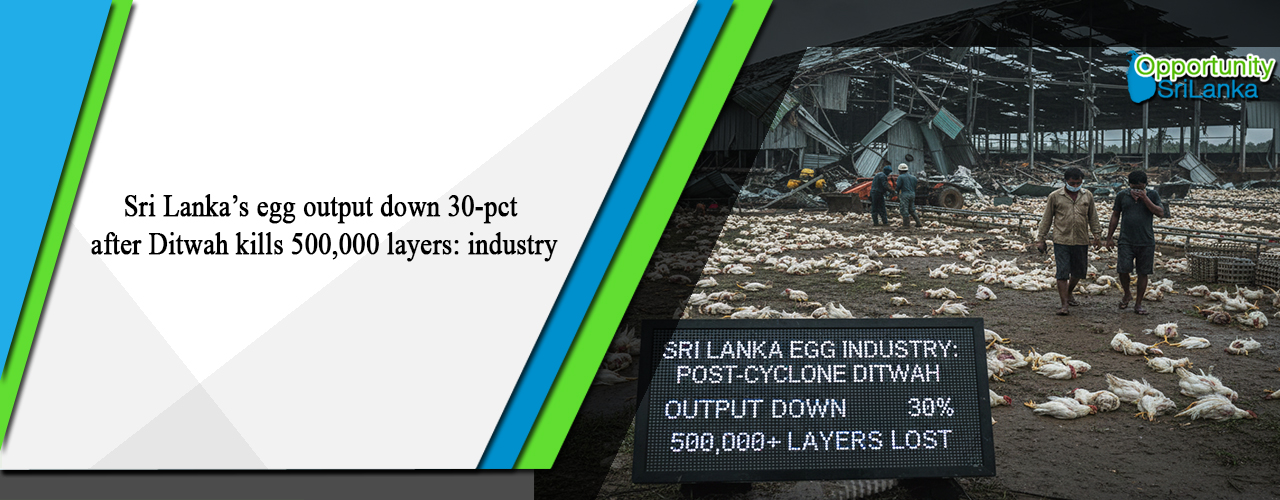
Sri Lanka’s egg output down 30-pct after Ditwah kills 500,000 layers: industry
EconomyNext: Sri Lanka’s daily egg output has slumped around 30 percent after Cyclone Ditwah killed around 500,000 layer chicken Ajith Gunasesekera, President of the All-Island Poultry Association said.
In Sri Lanka around 900,000 eggs are consumed, but lately production has risen to around 1,100,000 leading to reduced prices, he said.
Due to the high level of production, retail egg prices ranged around Rs. 22 to 25 to 28 based on size and farmgate prices Rs. 21 to 22, before the storm.
However, high maize prices in Sri Lanka from import controls, cost of egg production was estimated at 28 rupees.
Now egg prices have gone up to Rs. 43 to 45.
The 500,000 layers were in various stages of growth. It takes around five months for a chicken to mature and lay eggs.
Daily egg output was now estimated at 60,000, Gunasekera said.
“Feed was disrupted due to the floods to farms that were operating,” he said. “The chicken’s body automatically adjusts to save calcium when feed is reduced by reducing eggs. When electricity goes off, they also reduce laying.”
There was some excess production and there seems to be some reduced demand as domestic tourism has stopped and many events have also stopped, he said.
With higher egg prices, farms that survived in particular are willing to start replacing ageing layers and expand production.
Day-old chick prices, which collapsed to around Rs. 50 leading to culling during the floods, have now recovered to around Rs. 400 to 450 for layers and Rs. 275 to 350 for broilers, Gunasekera said.
“The higher prices are giving additional revenues but now maize prices have shot up to Rs. 200 per kilogram (compared to imported maize of around 120 rupees a kilo with a tax)
About 1.4 to 1.5 million broiler chicken have also died due to floods. Broiler chickens have a short cycle of around 35 days.
The Sri Lankan government has announced compensation of around Rs. 200,000 per farm.
OSL take:
In the aftermath of Cyclone Ditwah, there are many business/investment opportunities that have emerged, including in ensuring the country’s food security. These opportunities range from the supply of food items to rebuilding the affected agriculture and livestock industries. While Sri Lanka continues to receive urgent supplies, both the agriculture and livestock industries are in need of restarting operations. Given the Sri Lankan government’s commitment to rebuild stronger and better, it would also apply to the agriculture and livestock industries, thereby creating a host of business/investment opportunities for foreign businesses/investors on the lookout for ventures in the region, especially in Sri Lanka. The latest technologies and technical expertise as well as the development of infrastructure and supplementary infrastructure facilities required for rebuilding are among the key opportunities in the agriculture and livestock industries. With funding also being available for Sri Lanka’s rebuilding programme, foreign businesses/investors could explore the expanding business/investment opportunities in Sri Lanka’s agriculture and livestock industries while also looking at engaging in operations through local collaborations.
| Article Code : | VBS/AT/20251217/Z_4 |