
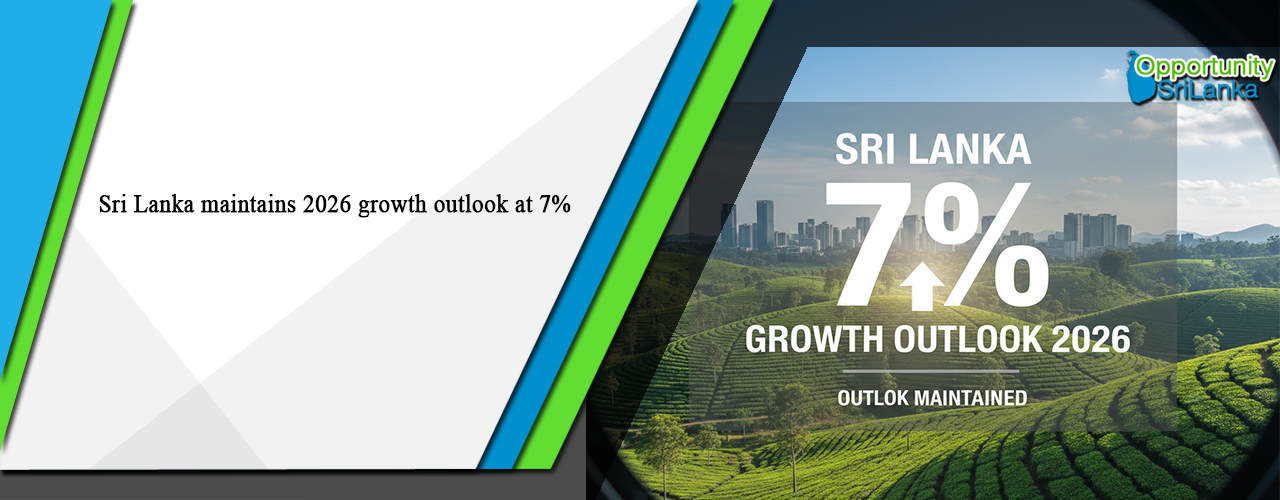
Sri Lanka maintains 2026 growth outlook at 7%
The Morning: The Deputy Minister of Finance Anil Jayantha Fernando during a programme on Ada Derana stated that the Government continues to maintain the growth target of 7% this year, though the World Bank and the IMF predict a much lower rate.
“As of now, the medium-term growth as was explained in the budget speech 2026 by President Anura Kumara Dissanayake, we target an inclusive and sustainable growth of more than 7%. The target has not changed. As of now, we are moving on the same trajectory to achieve this particular target in the medium term.”
The IMF and the World Bank project growth at 3.5%, and the Central Bank estimated growth at 4-5%.
Political Economist Researcher Shiran Illanperuma said during the programme: “Growth wasn’t a smooth drive from 2022 to 2026. With the reforms that have come with time and with a significant amount of the population affected, there are people who are unable to afford electricity, along with high taxes, high cost of living, high cost of utilities and a significant amount of people remain in poverty. We are experiencing higher poverty levels, and the earlier crisis of 2022. What has actually happened is that inflation levels have flattened slightly. But income levels have not risen to match that.”
Illanperuma added that The World bank and IMF both are projecting Sri Lanka’s growth is not going to be high as anticipated. This is accurate from a global perspective looking at the IMF growth forecast, globally. For the next year 2027 and 2028 growth is going to be muted for various reasons.
“We’ve been in a long recession since 2008, the global financial crisis. And Sri Lanka hasn’t come out of it yet. The effects of Ditwahare going to be a challenge. And it will be a challenge to mobilise investment into the country.”
He suggested that if the country is to grow it needs to have the investment to rebuild above and over the capital stock available in the country and to accumulate capital beyond the benchmark and have investments in new industries. And that is an aspect Sri Lanka is far away from.
Illanperuma stated that if global economic growth is projected to be slow, and the GDP rate is to go down, the potential for tax revenue is going to be lower. With less economic activities, the actual tax base is also to be lowered. These are macroeconomic dimensions and economic dynamics the Government must consider.
Furthermore, according to Illanperuma, in order for the Government to maintain its long term sustainability, particularly on the external side towards economic growth, the metrics the Government is looking for differs relatively from the actual dynamics to focus including; foreign currency inflows and export sector (apparel and textiles, tea, rubber-based products, coconut-based products and other goods).
OSL take:
Sri Lanka’s economic resilience towards internal and external shocks through the years is one of the main attractions to many foreign businesses/investors. The quick turnaround of the country after facing an unprecedented economic crisis in 2022 serves as the latest indication of Sri Lanka’s economic strength and resilience. With the country on a steady growth path and a target of becoming an emerging business destination in the region, there is currently an expansion in business/investment opportunities in all key economic sectors in Sri Lanka. The country’s strategic positioning in the Indian Ocean, the many trade agreements as well as trade concessions enjoyed by the country with many foreign countries and the improving ease of doing business environment in the country have all served to boost Sri Lanka as an emerging business destination. Apart from exploring business/investment opportunities, foreign businesses/investors could also look at setting up bases in Sri Lanka to engage with other countries in the region using the preferential treatment enjoyed by Sri Lanka with them. Given Sri Lanka’s growth and business potential, foreign businesses could also look at expanding their footprint in the region through local collaborations.
| Article Code : | VBS/AT/20260212/Z_2 |