
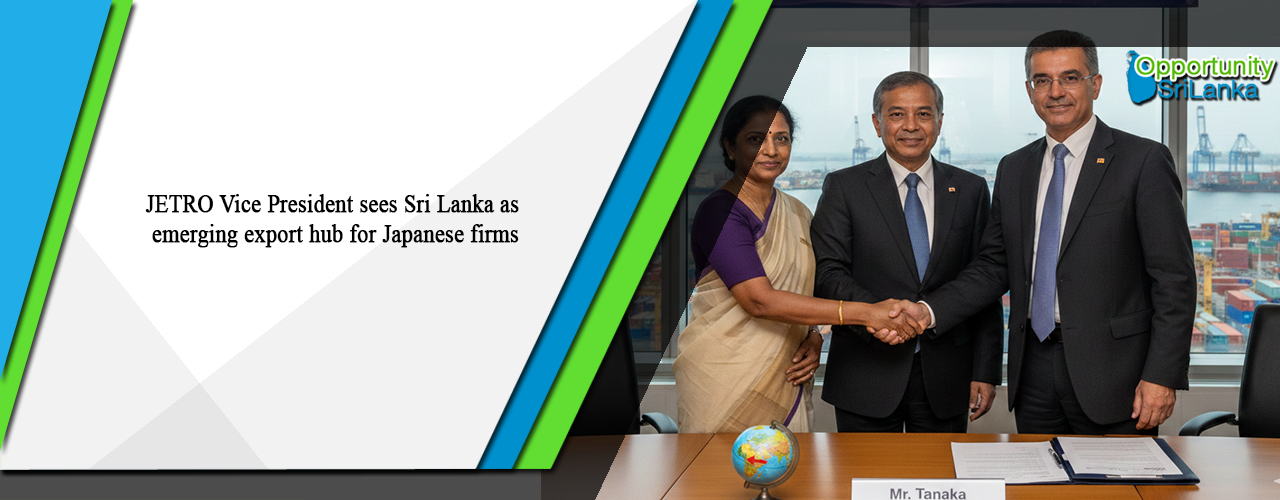
JETRO Vice President sees Sri Lanka as emerging export hub for Japanese firms
Daily FT: The Japan External Trade Organisation (JETRO) Executive Vice President Okumura Akiko yesterday said it is looking to reset and deepen economic ties with Sri Lanka, positioning the island as a potential export hub linking India, the Middle East and Africa.
“Japan and Sri Lanka are undergoing structural economic shifts, creating an opportunity to redefine bilateral cooperation over the next three to five years,” she told the Daily FT in an exclusive interview, during her first official visit to Colombo as a senior JETRO official.
Okumura noted that since President Anura Kumara Dissanayake’s visit to Japan last year, discussions have intensified on building what she described as “a new relationship” aligned with evolving global realities.
Following the ongoing economic policy dialogue between the two Governments, she said JETRO and Sri Lankan counterparts agreed to institutionalise annual high-level meetings, supplemented by more frequent online engagements to address investor concerns. “The important thing is implementation,” Okumura stressed.
With renewed Government-level dialogue, improving macroeconomic conditions and strategic port infrastructure, she said JETRO sees momentum building. “Sri Lanka can be an export hub. We see real possibilities,” she emphasised.
Okumura said a key pillar of JETRO’s strategy is Sri Lanka’s geographic positioning. Sri Lanka’s natural deep-sea ports and its proximity to India, one of the world’s fastest-growing economies is a great advantage.
“With natural deep-sea ports with capacity and growing cargo movement between India and other regions, Sri Lanka has the potential to become a great export hub for Japan. From here, businesses can expand not only to India, but also to the Middle East and Africa,” she added.
She said JETRO operates five offices in India, including in Chennai, enabling coordination between Japanese businesses in southern India and Sri Lanka. Okumura suggested that triangular trade between Japan, India and Sri Lanka could expand significantly in the coming years.
While automobiles remain a major Japanese export to Sri Lanka, Okumura indicated that interest is broadening. A Japanese business delegation scheduled to visit Sri Lanka next month will represent diverse sectors including; environmental equipment, agriculture and food processing, machinery and industrial manufacturing, trading and logistics and electronics.
“Some companies are exploring factory set-ups, while others are assessing export-oriented production models,” she confirmed.
Although no formal inquiries have yet been made regarding automobile assembly plants in Sri Lanka, Okumura described the Sri Lankan market as “very important” for Japanese brands. “Japanese companies are paying more attention to this market,” she said.
Amid shifting geopolitical dynamics, Okumura said Japan is increasingly focused on diversifying supply chains, particularly in securing critical minerals and rare earth-related materials.
She noted that JETRO researchers have identified high-purity mineral resources in Sri Lanka that could be of strategic interest to Japanese industries. “We are looking to connect Sri Lanka’s valuable resources with Japanese companies,” she said, adding that such linkages could strengthen supply chain diversification efforts.
“As Japan seeks diversified supply chains and regional integration across the Indo-Pacific, Sri Lanka may once again find itself playing a pivotal role in bilateral economic cooperation — this time as a gateway linking South Asia to wider global markets,” she added.
OSL take:
Sri Lanka’s manufacturing and export sectors have been on a steady growth path and are continuing on the path. The many trade agreements as well as trade concessions enjoyed by the country with many foreign countries and Sri Lanka’s geographical positioning in the Indian Ocean providing quick access to foreign markets have helped boost the country’s manufacturing and export sectors while also expanding the business/investment opportunities in the sectors. With local manufacturers and exporters working on adding more value to local exports while also working on diversifying their export product portfolios resulting in increased foreign market access, the expanding opportunities in Sri Lanka’s manufacturing and export sectors present lucrative ventures for foreign businesses/investors. Also, as noted by the JETRO official, Sri Lanka could also be used as a destination for foreign businesses/investors to set up bases, especially in manufacturing and export, to engage with countries in the region where Sri Lanka enjoys strong trade ties with. Such foreign businesses could also look at expanding operations through partnerships or joint ventures with local businesses already engaged in the manufacturing and export sectors.
| Article Code : | VBS/AT/20260223/Z_3 |